Social Interaction Is the Single Most Important Factor for Seniors with Dementia and Alzheimer's
A landmark study of over 800 seniors with dementia found that just one hour of social interaction per week significantly improves quality of life. Learn what the research says — and how RUKUN applies it.

A caregiver engaging in warm social interaction with an elderly resident living with dementia
Social Interaction Is the Single Most Important Factor for Seniors with Dementia and Alzheimer's
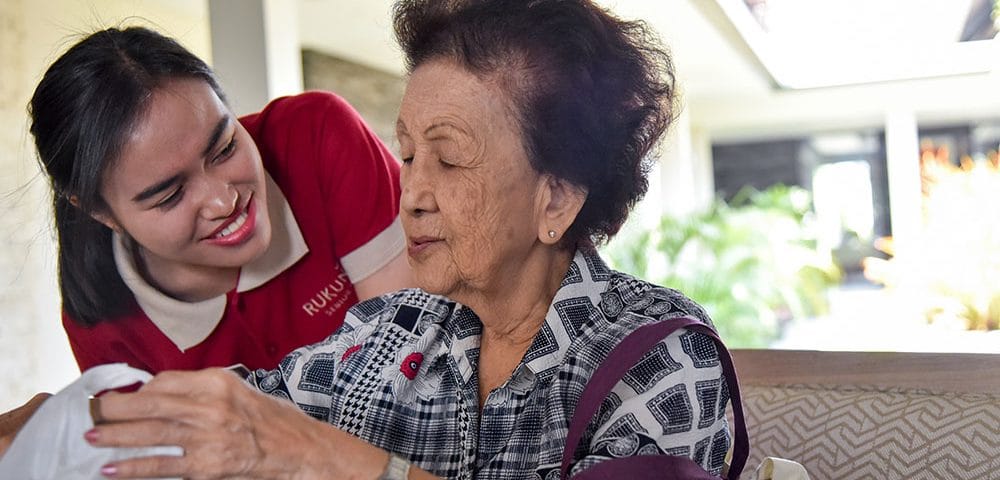
Interacting with — or caring for — a senior with dementia and Alzheimer's is not easy. It is understandable, then, that people with dementia are sometimes inadvertently isolated by those around them. Yet in reality, social interaction is precisely what makes caring for a person with dementia more manageable — not less. A research study by the University of Exeter Medical School in England concluded that even a minimum of one hour of social interaction per week can improve the quality of life of people with dementia. The conclusion is clear: social interaction for people with dementia and Alzheimer's is not a luxury — it is a necessity.
The Benefits of Social Interaction in Dementia: What the Research Shows
The study, involving more than 800 seniors with dementia across 69 senior residential facilities in England, found that increasing the amount of time spent in social interaction improved the wellbeing of senior residents when combined with care services tailored to individual needs. Beyond improving quality of life, increased socialisation also reduced levels of agitation and aggressive behaviour among residents.
Professor Clive Ballard, who led the study, stated: "Although many care providers are excellent, standards still vary considerably. We previously found that the average amount of social interaction for a person with dementia and Alzheimer's was just two minutes per day. It is therefore unsurprising that this has a direct effect on their quality of life and their levels of agitation."
The study was funded by the National Institute of Health Research and ran from January 2013 to September 2015. Participants with dementia were randomly selected either to join the programme for nine months or to continue with their normal daily routine. At the end of the period, all participants were assessed on quality of life, incidence of agitation, and other symptoms.
Two care staff members at each senior residential facility were assigned to carry out simple tasks — such as interacting with residents about their personal interests and aspects of their care. The resulting data analysis showed statistically significant improvements. Residents who participated in the programme were found to experience greater happiness compared to those who did not. The greatest benefits were found among residents with more advanced stages of dementia. This research — led by the University of Exeter, King's College London, and Oxford Health NHS Foundation Trust — is recognised as the largest validated study measuring the wellbeing of people with dementia living in senior residential care.
The Next Challenge
Dr. Jane Fossey of Oxford Health NHS Foundation Trust explained that a person-centred approach requires getting to know each resident as an individual — understanding their unique wishes and preferences, and reflecting these across every aspect of their care. This can improve quality of life for the residents themselves, and is also beneficial for the staff who provide their care.
According to the Alzheimer's Society in England, approximately 850,000 people are living with dementia. Dementia and Alzheimer's represent the country's greatest health challenge, with the number of people living with dementia projected to reach over one million by 2025 and two million by 2051.
Doug Brown, Director of Research at Alzheimer's Society, said: "This study shows that training care staff in person-centred care, activities, and social interaction can have a significant impact on the wellbeing of people with dementia in residential care settings."
As a provider of Dementia Support Solutions, RUKUN serves seniors with dementia through residential and day centre services to optimise their daily lives across three locations:
RUKUN Senior Care, Sentul
RUKUN Dementia Support Center, Cipete
RUKUN Group Home, Bintaro
With a warm, interaction-rich environment, RUKUN provides a high quality of daily life for residents who require additional care and attention.
For families caring for a loved one with dementia at home, read our tips on communicating with a person with dementia.
RUKUN Dementia Support Solution
Email: info@rukunseniorliving.com
Phone: 021 8795 1525
Reference: The Guardian — Social Interaction and Dementia Patients (7 Feb 2018)
A University of Exeter study involving more than 800 seniors with dementia across 69 residential facilities in England found that just one hour of social interaction per week was sufficient to significantly improve quality of life. Residents who participated in a structured social interaction programme experienced greater happiness and lower levels of agitation and aggressive behaviour compared to the control group.
According to Professor Clive Ballard of the University of Exeter, although many senior care providers are excellent, standards still vary considerably. Prior to this study, the average amount of social interaction for a person with dementia in a care facility was just two minutes per day — far below the threshold shown to be beneficial.
Person-centred care is a care approach that requires getting to know each resident as a unique individual — understanding their personal wishes and preferences and reflecting these across every aspect of their care. Dr. Jane Fossey of Oxford Health NHS Foundation Trust noted that this approach can improve quality of life for residents while also benefiting the care staff who provide their services.
RUKUN provides dementia care services at three locations: RUKUN Senior Care in Sentul (Bogor), RUKUN Dementia Support Center in Cipete (South Jakarta), and RUKUN Group Home in Bintaro. All three are operated by PT. RUKUN SAHABAT SENIOR and offer residential and day centre services to optimise daily life for people with dementia.
According to the Alzheimer's Society in England, approximately 850,000 people were living with dementia at the time of the study. This figure is projected to rise to over one million by 2025 and two million by 2051, making dementia the country's single greatest health challenge.